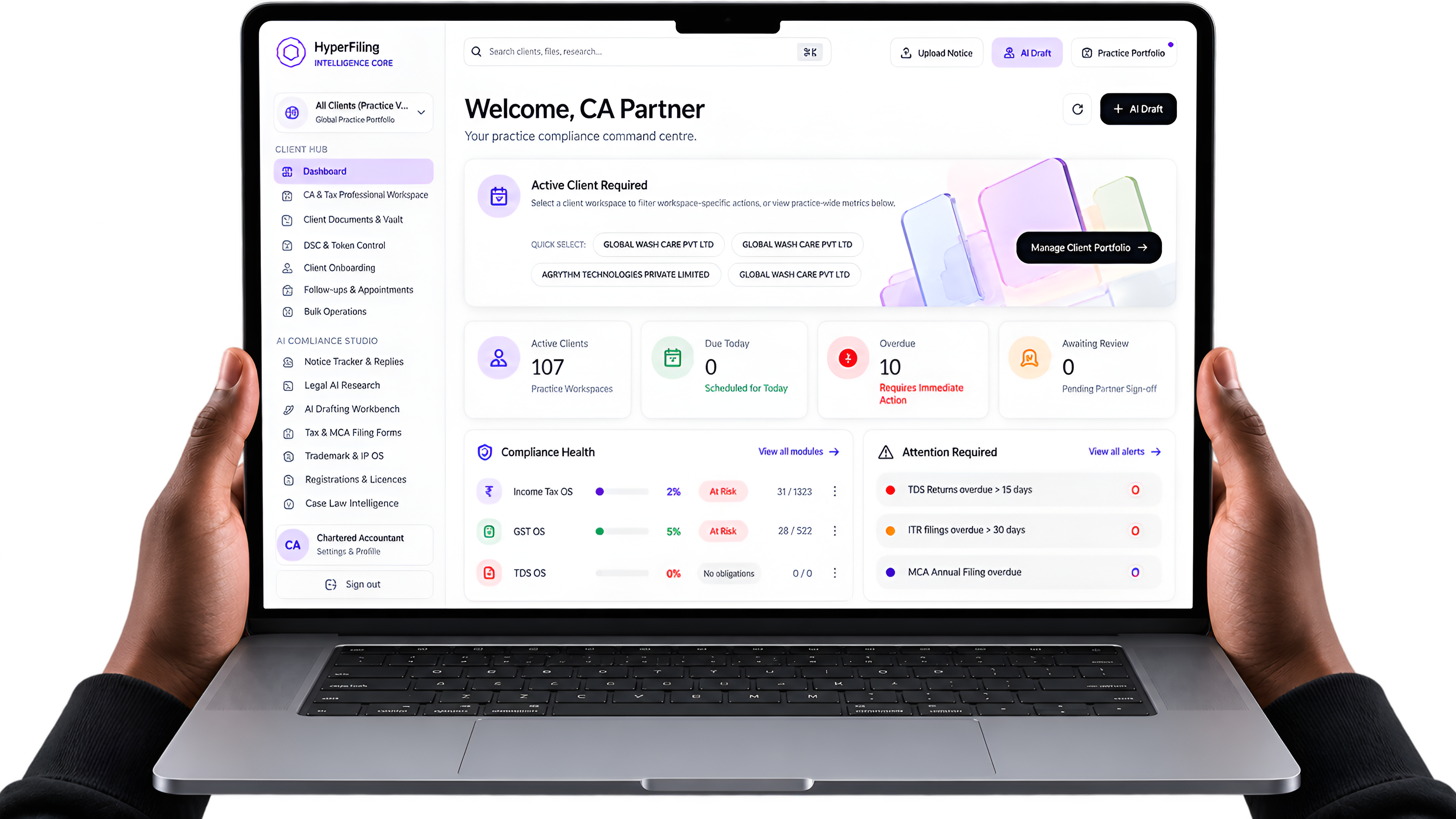
Every filing,cited to the Act.

Every client,one compliance dashboard.
Practice-wide status for Income Tax, GST and TDS, the notices awaiting reply, and the drafts ready for partner sign-off.
Grounded in theprimary sources.
Research runs over statutory text, not over what a language model remembers about statutory text, and every answer is cited to a bare-act source you can open and read.
Can I claim ITC on this invoice?
Yes, subject to the conditions in
Section 16, CGST ActEvery answer, cited
The provision an answer rests on arrives attached to it, not left for someone to go and find.
Citation guarantee
Not a summary of the law.
Every answer carries the bare-act passage it was built from. Open it and read the words the answer used.


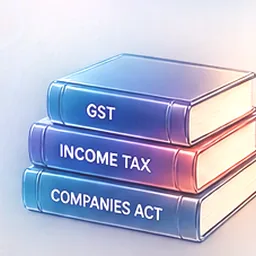


One search, five statutes
Retrieval runs across the Income-tax Act, CGST & IGST, Companies Act, SEBI LODR and IBC in a single pass.
- Income-tax Act
- CGST & IGST
- Companies Act
- SEBI LODR
- IBC, 2016

Global Wash Care Pvt Ltd
MCA21 master data
- Incorporated
- 14 Mar 2019
- Status
- Active
Verified against the register
CIN, incorporation date and status, read from the dataset MCA21 publishes on data.gov.in.
Five jobs, done inone workspace.
Every one of these exists in production today. Nothing on this list is a roadmap item wearing a present tense.
- 01
Client workspaces that stay separated
Each client sits in its own workspace, and every query is scoped to the workspaces you belong to. Associates see the clients they are assigned; partners keep firm-wide oversight without anyone sharing a login.
- Workspace isolation
- Role-scoped access
- Bulk onboarding
- 02
Notices read on upload, not retyped
Drop in a scanned Income Tax notice. The DIN, assessment year and statutory response deadline are extracted from the scan itself, including the fuzzy ones that came off a departmental fax. GST and MCA notice types are not in the tracker yet.
- PDF & image OCR
- DIN extraction
- Deadline capture
- 03
Research that shows its working
Ask a question and get an answer built from retrieved statutory passages, each one linked back to the section, proviso or circular it came from. The passage that produced the answer is the passage you can open.
- Bare-act retrieval
- Linked citations
- Case law
- 04
GSTR-2B against the books, line by line
Import the purchase register and match input tax credit invoice by invoice. Mismatches are flagged where they occur, with the rate delta and the vendor attached, rather than as a single reconciliation total.
- 3-way match
- ITC mismatch
- Vendor risk
- 05
Drafts a reviewing partner can check
GST show-cause replies under sections 73 to 75, income-tax appeals under sections 246A, 250 and 253, board resolutions and AGM minutes — each argument naming the provision it rests on. Every action is logged with the user and timestamp, so the file explains itself a year later.
- Reply drafting
- Cited provisions
- Audit trail
From a scanned noticeto a filed reply.
Step one
Drop the notice in
A scan, a PDF, a photograph of a paper order. The DIN, the assessment year, the section invoked and the date the reply is due come off the document itself and land on the client workspace.
Step two
Check it against the Act
Ask what the section requires, what the threshold is, what the department has to establish first. The answer arrives with the passages it was built from, ready to be read rather than trusted.
Step three
Draft, review, file
A reply drafted with each argument attached to its provision, marked up by the partner, exported as a formal package, and logged, so the file still explains itself at assessment.


Four instalments,one financial year.
Advance tax falls due in June, September, December and March. Income-tax dates in HyperFiling carry the provision they derive from, so a reviewing partner can check the date instead of taking it on trust.
- 15%by 15 June
- 45%by 15 September
- 75%by 15 December
- 100%by 15 March
Each figure is cumulative and net of what was already paid. Assessees under the presumptive schemes in sections 44AD and 44ADA pay the whole of it in a single instalment by 15 March.
Built for legal reasoning,not for data entry.
Firms already run filing software and a task tracker. Neither category reads a notice or checks a position against the Act, which is the part that consumes a senior's afternoon.
Legacy tax software
Winman, CompuTax, Genius and the rest of the desktop generation
- Computes and prepares the return
- No legal grounding behind a position
- Notices arrive as an attachment to retype
- Reconciliation limited to a Tally import
Practice management tools
Task trackers built to allocate work, not to do it
- Tracks who owes what by when
- No statutory text anywhere in the product
- Documents stored, never read
- Due dates typed in by hand each year
HyperFiling
The statutory layer the other two assume you supply yourself
- Answers built from retrieved statutory text
- Notices read on upload, DIN and dates extracted
- GSTR-2B matched against books invoice by invoice
- Income-tax due dates name the section they derive from
You should not have to trust it.You should be able to check it.
Any tool can produce a confident paragraph. The question a reviewing partner asks is where it came from. These are the four mechanisms that answer it.
- 01
Answers are drafted against retrieved text
Research runs over a statutory corpus rather than model memory. The passages used to build an answer are the passages you can open and read.
- 02
The model is instructed not to fill gaps
Prompts require the system to work from the supplied source and to mark what is illegible or absent, instead of inventing around it.
- 03
Income-tax due dates name their section
Income-tax deadlines carry the provision they derive from, so a reviewer can verify the date rather than accept it. GST, TDS and ROC dates do not yet cite theirs.
- 04
Unconfirmed rules are labelled, not hidden
Where we have not checked a date against primary source text ourselves, it is flagged for your confirmation instead of shown as settled.
Priced per firm.Not per seat.
Every plan carries unlimited user seats. A firm should not have to decide whether an article assistant is worth a licence.
Starter
For independent practitioners and small firms.
- Unlimited user seats
- Up to 50 active client workspaces
- 500 AI queries / month
- 200 document analyses / month
- Compliance calendar + notice tracker
- Source-cited legal research with bare-act references
- Document drafting with embedded citations
- Daily updates digest
Growth
For scaling practices with growing client portfolios.
- Unlimited user seats
- Up to 150 active client workspaces
- 2,000 AI queries / month
- 1,000 document analyses / month
- Audit log export
- Priority support
- Everything in Starter
Enterprise
For listed-company audit practices and large CS firms.
- Unlimited user seats
- Unlimited active workspaces
- Custom AI query and document analysis quotas
- SSO (SAML / OIDC)
- Dedicated customer success manager
- Service Level Agreement
- Procurement-ready DPA and security questionnaire
Before yousign anything.
The rest are answered on the pricing page, along with the full plan comparison.
Notice → reply